The control frameworks that work for evaporation ponds fail for electrochemical DLE not because engineers applied them carelessly, but because the two technologies operate on incompatible timescales. Recognizing that mismatch is the first step toward understanding what a DLE control paradigm actually requires.
How Evaporation Pond Control Works
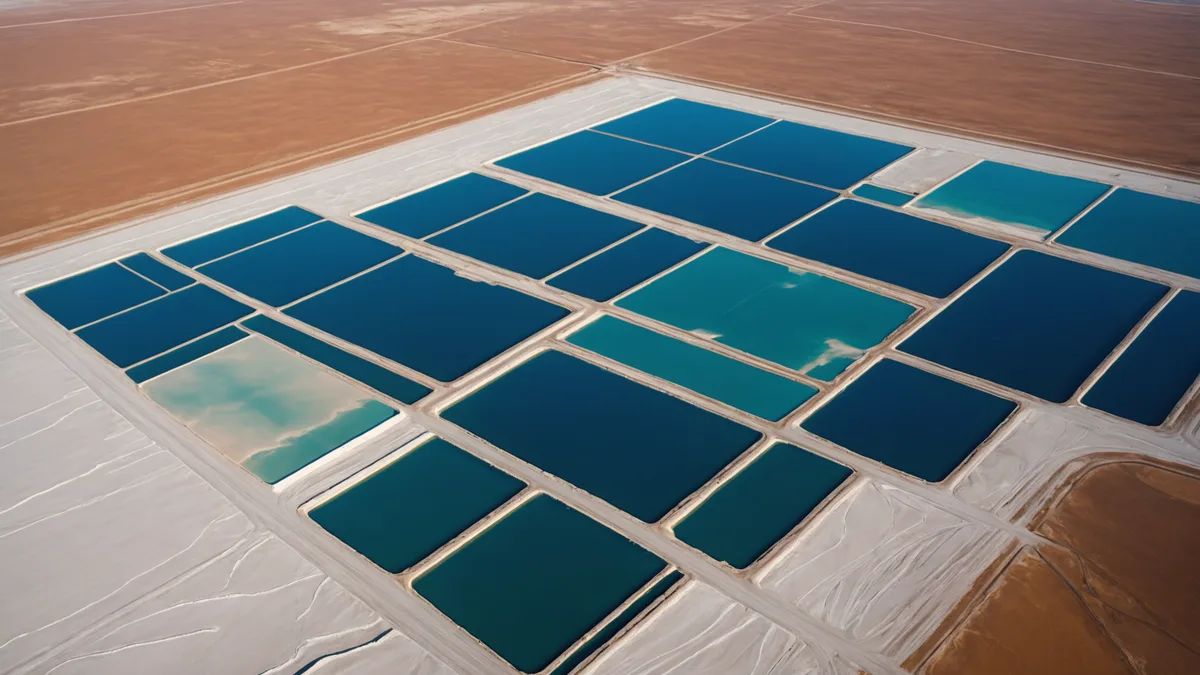
Traditional lithium production from salar brines via evaporation ponds operates on timescales of 12 to 18 months from first brine pumping to harvested lithium product. The "control" in this process is a sequence of manual interventions: pumping brine between pond stages as concentrations reach target thresholds, managing pond inflows to maintain target levels, adjusting harvest timing based on brine grade. The measurement intervals that matter are weeks to months. A sample taken today and analyzed in a lab by next week is more than adequate for making operational decisions.
The evaporation pond operator's mental model of the process is: slow-moving chemistry, large buffers against disturbances (the ponds themselves), and infrequent decisions with long implementation times. The "control loop" has a cycle time measured in days. The consequence of a wrong decision is recoverable over weeks by pumping brine between ponds and adjusting the process.
This mental model is reasonable for the technology it describes. The problem is that it was directly inherited by early DLE projects, because many of the engineers commissioning the first DLE plants came from evaporation pond operations. They understood the brine chemistry and the lithium extraction goals. They did not have the background to immediately recognize that the control philosophy needed to be completely different.
What Electrochemical DLE Actually Needs
An electrochemical DLE cell operates on a fundamentally different timescale. A single adsorption phase in a typical lab-to-pilot-scale DLE cell runs 20 to 90 minutes. A full adsorption-elution cycle completes in 40 to 180 minutes. A multi-cell plant running multiple cycles per day processes its feed brine through a complete extraction cycle in hours, not months. If you want to run this process efficiently, the relevant measurement interval is minutes, not weeks, and the relevant decision frequency is hours, not months.
The consequences of a wrong operating decision propagate to product quality and recovery within one to three cycles, not over weeks. A setpoint that is appropriate for one brine composition will be wrong for a different composition within the same operating day. An electrode that is developing fouling will show measurable efficiency changes within tens of cycles, which at three cycles per day is observable within a week of fouling onset.
At the same time, the "buffers" that made evaporation pond operations forgiving are absent in electrochemical DLE. There is no large pond volume that averages out day-to-day composition variation. The electrode state at the end of one cycle directly determines the starting conditions for the next. Compounding inefficiencies accumulate across cycles in a way that does not have a direct analog in pond operations.
The SCADA Transfer and Why It Is Insufficient
Recognizing that DLE needs active control, most DLE projects deploy industrial SCADA (Supervisory Control and Data Acquisition) systems with PID loops managing electrode potential or current. This is a significant improvement over manual setpoints checked weekly. A SCADA PID loop can respond to a measured deviation from setpoint in seconds. That is the right speed for the technology.
The inadequacy of the SCADA PID approach is not in its response speed but in what it controls toward. A PID loop controls to a fixed setpoint: electrode potential X, or current density Y, or cycle duration Z minutes. It responds when the measured variable deviates from that fixed setpoint. But the correct setpoint is not fixed: it changes with brine composition, temperature, electrode state of charge, and electrode age. A PID loop optimally maintaining an incorrect setpoint is still delivering incorrect electrode operation.
The setpoint change from evaporation pond operations to DLE involves accepting that the target electrode operating parameters are dynamic, not static. The "set and forget" of pond operations, where a seasonal setpoint adjustment once per quarter was sufficient, does not apply. The setpoint is the output of a model that runs continuously, and the model's inputs are real-time process measurements. This is a control paradigm shift, not just a faster version of the same approach.
What a Fit-for-Purpose Control Paradigm Looks Like
A DLE control paradigm designed for the technology rather than inherited from a different technology has four key properties: continuous measurement of the variables that drive electrode behavior, a model that predicts electrode response to those variables rather than a static setpoint, adaptive setpoint outputs that change as model inputs change, and a feedback layer that detects discrepancies between predicted and actual behavior and uses them to update the model.
This is model predictive control (MPC) in its conceptual structure, though the implementation for DLE does not need the full mathematical apparatus of industrial MPC as used in complex chemical plants. A semi-empirical kinetic model calibrated from commissioning data, updated through online parameter estimation as the electrode ages, and computing setpoint updates on a 60 to 90 second cycle is sufficient for DLE process control in most applications. The key conceptual move is from "what setpoint should I set?" (a static question) to "what does the electrode need right now, given its current state and the current brine composition?" (a dynamic question).
The transition also requires a different relationship between the control system and the operator. In evaporation pond operations, the operator makes infrequent high-judgment decisions about pond sequencing and harvest timing, and the control system (to the extent one exists) executes those decisions. In DLE with adaptive control, the frequent cycle-level decisions (when to terminate adsorption, what electrode potential to use in the next cycle phase, which cell to transition to elution next) are handled automatically by the control model. The operator's role shifts toward monitoring model performance, responding to alerts, and making longer-timescale decisions about maintenance scheduling and operational configurations. That is a different job than evaporation pond operations required, and transitioning the workforce accordingly is part of deploying the technology successfully.
Evidence from the Transition
The efficiency gap between evaporation pond operations and electrochemical DLE should not obscure the fact that DLE with fixed-setpoint SCADA is already a significant improvement over ponds for many lithium producers, particularly in water-stressed regions where pond evaporation requires large land areas and consumes fresh water resources. We are not arguing that the current generation of DLE control approaches has failed. We are arguing that there is a measurable efficiency gap between fixed-setpoint DLE operation and adaptive DLE operation, and that gap is attributable to control philosophy rather than electrode material or hardware limitations.
In the three-brine-chemistry validation series we ran in 2024, the difference between fixed-setpoint control and adaptive control was 89% versus 71% cycle efficiency, on the same electrode stack, same hardware, same feed brines. The electrode was not the limiting factor in the fixed-setpoint case. The control layer was. Closing that 18-percentage-point gap represents a meaningful improvement in lithium recovered per unit of capital deployed in the DLE plant, which at current lithium market economics translates directly to project viability for resources that are marginal on fixed-setpoint economics but viable on adaptive-control economics.
That is the practical argument for the new control paradigm: not that the old approach is wrong in principle, but that the efficiency gap it leaves behind is large enough to matter for project economics, and it is recoverable with better control logic rather than more capital equipment.